
The Artemis program is organized around a series of SLS missions. These space missions will increase in complexity and are scheduled to occur at intervals of a year or more. NASA and its partners have planned Artemis I through Artemis V missions; later Artemis missions have also been proposed. Each SLS mission centers on the launch of an SLS launch vehicle carrying an Orion spacecraft. Missions after Artemis II will depend on support missions launched by other organizations and spacecraft for support functions.
The Space Launch System, Orion spacecraft and the Human Landing System form the main spaceflight infrastructure for Artemis, and the Lunar Gateway plays a supporting role in human habitation. Supporting infrastructures for Artemis include the Commercial Lunar Payload Services, development of ground infrastructures, Artemis Base Camp on the Moon, Moon rovers, and spacesuits. Some aspects of the program have been criticized, such as the use of a near-rectilinear halo orbit and the program’s sustainability.
Orion’s first launch on the Space Launch System was originally set in 2016, but faced numerous delays; it launched on November 16, 2022, as the Artemis I mission, with robots and mannequins aboard. As of November 2025, the crewed Artemis II launch is scheduled for February 8, 2026, the Artemis III crewed lunar landing is expected to launch no earlier than mid-2027, the Artemis IV docking (with the Lunar Gateway) is planned for late 2028, the Artemis V docking (with the European Space Agency’s ESPRIT, Canada’s Canadarm3, and NASA’s Lunar Terrain Vehicle) is planned for early 2030, and the Artemis VI docking (which is expected to integrate the Crew and Science Airlock with the Lunar Gateway station) is planned for early 2031. After Artemis VI, NASA plans yearly landings on the Moon from then on.
The program faced its greatest threat due to the economics of launch changing drastically in the early 2020s because of reusable launch vehicles. After multiple sessions of Congress debated the viability of the program, it was ultimately funded by the passage of the 2025 One Big Beautiful Bill Act.[9]
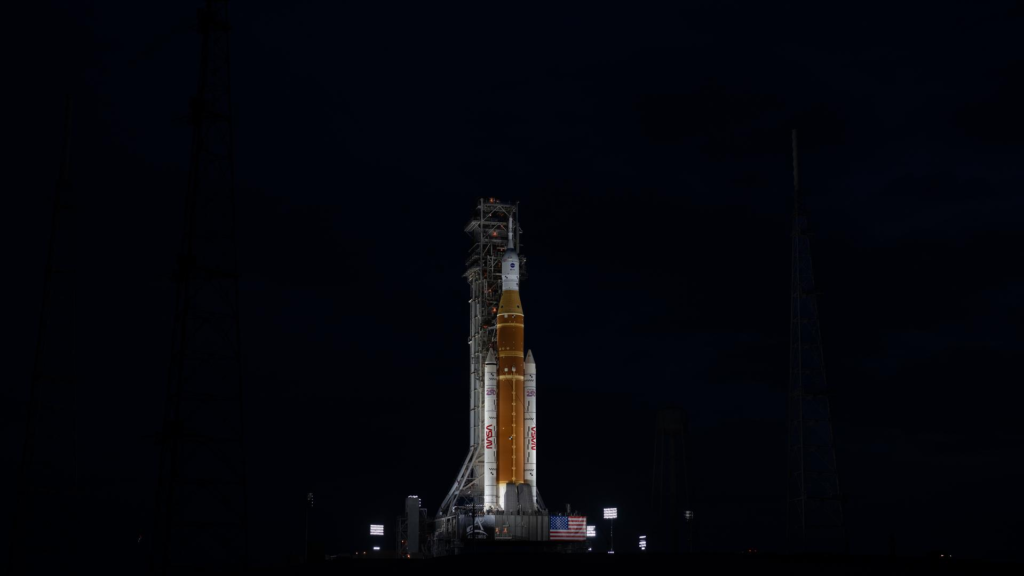
NASA/Brandon Hancock
SLS missions
- Artemis I (November 16, 2022 – 01:47:44 AM EST) was the successful uncrewed test of the SLS and Orion, and was the first test flight for both craft.[i] The Artemis I mission placed Orion into a lunar orbit and then returned to Earth. The SLS Block 1 design uses the Interim Cryogenic Propulsion Stage (ICPS) second stage, which performs the trans-lunar injection burn to send Orion to lunar space. For Artemis I, Orion braked into a polar distant retrograde lunar orbit and remained for about six days before boosting back toward Earth. The Orion capsule separated from its service module, re-entered the atmosphere for aerobraking, and splashed down in the Pacific Ocean under parachutes.[10]
- Artemis II (February 8, 2026 – 23:20:00 PM EST) is planned to be the first crewed test flight of SLS and the Orion spacecraft.[11] The four crew members will perform extensive testing in Earth orbit, and Orion will then be boosted into a free-return trajectory around the Moon, which will return Orion to Earth for re-entry and splashdown. Launch is scheduled for no earlier than February 8, 2026 and no later than April 30, 2026.[11][12]
- Artemis III (2027–2028) is planned to be the first American crewed lunar landing since Apollo 17 in December 1972.[11] The mission depends on a support mission to place a Starship Human Landing System (HLS) in a near-rectilinear halo orbit (NRHO) of the Moon prior to the launch of SLS/Orion. After Starship HLS reaches NRHO, SLS/Orion will send the Orion spacecraft with a crew of four to dock with HLS.[ii] Two astronauts will transfer to HLS, which will descend to the lunar surface and spend about 6.5 days on the surface.[13] The astronauts will perform at least two extravehicular activities (EVAs) on the surface before the HLS ascends to return them to a rendezvous with Orion. Orion will return the four astronauts to Earth. Launch is scheduled for no earlier than mid-2027.[11][12]

- Artemis IV (2028–2029) is planned to be the second crewed lunar landing mission.
- Artemis V (2030–2031) is planned to be the third crewed lunar landing, which will deliver four astronauts to the Lunar Gateway station.
- Artemis VI (2032) is planned to be the fourth crewed lunar landing, which will integrate the Crew and Science Airlock Module with the Gateway space station.[14] Launch is scheduled for no earlier than March 2031.[15] As of 2024, the Airlock module is under construction.[16]
- Artemis VII (2033) is planned to be the fifth crewed lunar landing, which will deliver the Habitable Mobility Platform (Lunar Cruiser) to the surface of the Moon on an SLS Block 1B rocket. Launch is scheduled for no earlier than March 2032.[17]
- Artemis VIII (2034) is planned to be the sixth crewed lunar landing, which will have a lunar landing with the delivery of lunar surface logistics and the Foundational Surface Habitat using an SLS Block 1B rocket with the aid of Blue Origin. Launch is scheduled for no earlier than 2033.[18]
- Artemis IX (2035) is planned to be the seventh crewed lunar landing, which will have another lunar landing with the delivery of additional lunar surface logistics. Unlike Artemis VIII, however, this mission will be the first to use an SLS Block 2 rocket.[19]
- Artemis X (2036) is planned to be the eighth crewed lunar landing, which will feature the delivery of additional lunar surface logistics using an SLS Block 2 rocket, and will also include astronauts staying on the Moon for an extended period of time.[19]
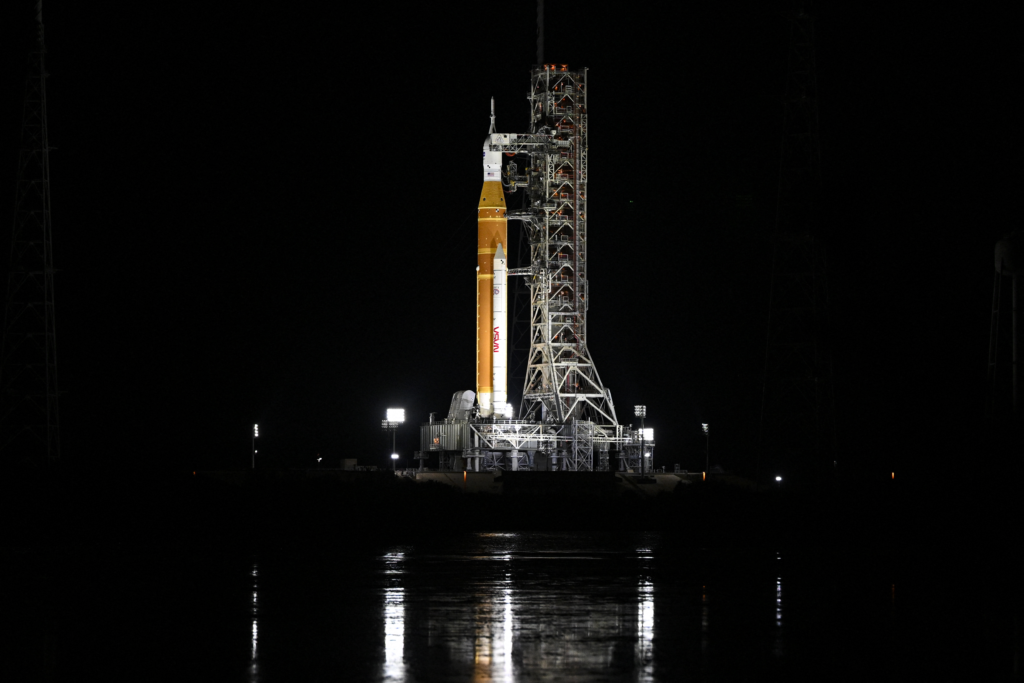
Planning is ongoing for Artemis IV and V. For the first, Orion and an upgraded Starship HLS will dock with the Lunar Gateway station in NRHO prior to the landing. The extra power of this mission’s SLS Block 1B will allow it to deliver the I-HAB Gateway module for connection to the Lunar Gateway. Launch is scheduled for no earlier than September 2028.[20][21] The mission will deliver the European Space Agency‘s ESPRIT refueling and communications module and Canadarm3, a Canadian-built robotic arm system for the Gateway. Also delivered will be NASA’s Lunar Terrain Vehicle. Launch is scheduled for no earlier than March 2030.[20][15] The mission will also be the first to use Blue Origin‘s Blue Moon lander to take astronauts to the Moon’s surface.
For many Artemis program missions, the Space Launch System’s two solid rocket boosters’ engines and casings and four main engines and the Orion spacecraft’s main engine will all be previously flown Space Shuttle main engines, solid rocket boosters, and Orbital Maneuvering System engines. They are refurbished legacy engines from the Space Shuttle program, some of which even date back to the early 1980s. For example, Artemis I had components that flew on 83 of the 135 Space Shuttle missions. From Artemis I to Artemis IV recycled Shuttle main engines will be used before manufacturing new engines. From Artemis I to Artemis III recycled Shuttle solid rocket boosters’ engines and steel casings will be used before manufacturing new ones. From Artemis I to Artemis VI the Orion main engine will use six previously flown Space Shuttle OMS engines.[22][23][24]
Support missions
Support missions include robotic landers, delivery of Gateway modules, Gateway logistics, delivery of the HLS, and delivery of elements of the Moon base. Most of these missions are executed under NASA contracts to commercial providers.
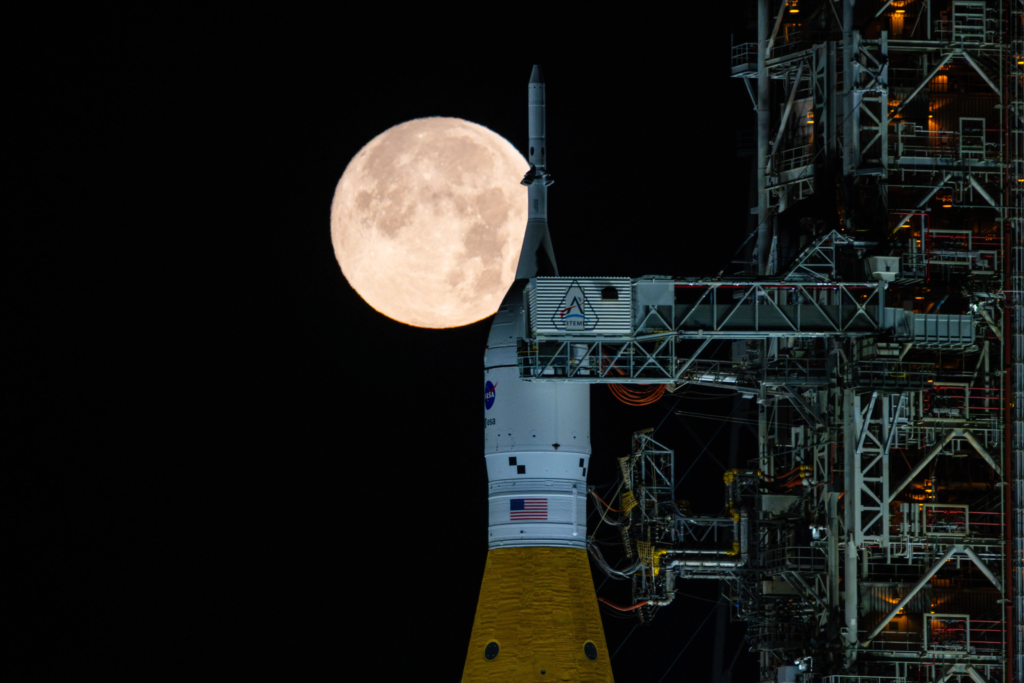
Under the Commercial Lunar Payload Services (CLPS) program, several robotic landers will deliver scientific instruments and robotic rovers to the lunar surface after Artemis I. Additional CLPS missions are planned throughout the Artemis program to deliver payloads to the Moon base. These include habitat modules and rovers in support of crewed missions.
A Human Landing System (HLS) is a spacecraft that can convey crew members from NRHO to the lunar surface, support them on the surface, and return them to NRHO. Each crewed landing needs one HLS, although some or all of the spacecraft may be reusable. Each HLS must be launched from Earth and delivered to NRHO in one or more launches. The initial commercial contract was awarded to SpaceX for two Starship HLS missions, one uncrewed and one crewed as part of Artemis III. These two missions each require one HLS launch and multiple fueling launches, all on SpaceX Starship launchers. NASA later exercised an option under the initial contract to commission an upgraded Starship HLS for Artemis IV and a separate contract to Blue Origin to develop a third crewed lunar lander, which will make its first crewed flight as part of the Artemis V mission.
The first two Gateway modules (PPE and HALO) will be delivered to NRHO in a single launch using a Falcon Heavy launcher. Originally planned to be available prior to Artemis III, as of 2021, it is planned for availability before Artemis IV.
The Gateway will be resupplied and supported by launches of Dragon XL spacecraft launched by Falcon Heavy. Each Dragon XL will remain attached to Gateway for up to six months. The Dragon XLs will not return to Earth, but will be disposed of, probably by deliberate crashes on the lunar surface.
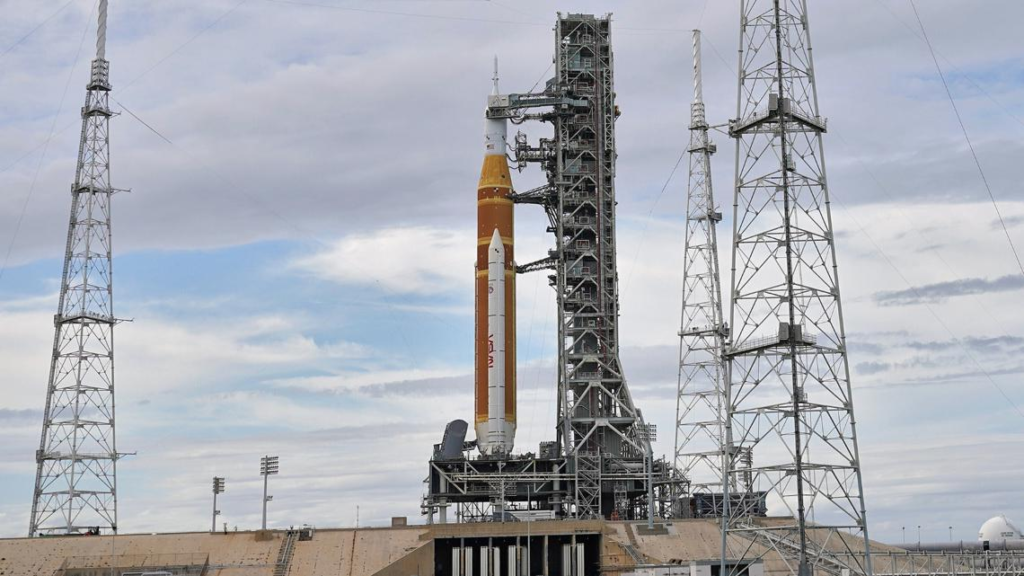
NASA’s Artemis II closeout crew has completed its critical tasks and departed NASA Kennedy’s Launch Complex 39B during the Artemis II wet dress rehearsal.
The departure of the closeout crew marks the transition to the final countdown phase, ensuring the launch pad is clear and safe for simulated liftoff procedures. Although the Artemis II astronauts did not participate in today’s rehearsal, the closeout crew’s work validates launch day protocols and confirms Orion and the SLS (Space Launch System) rocket are configured for flight readiness.
With the pad secured, teams will continue monitoring fueling operations and prepare for wet dress rehearsal terminal count, the final ten minutes of the countdown. The team will be conducting a single terminal countdown for this test.
A 24/7 live stream of the rocket at the pad remains online, as well as a separate feed to capture wet dress activities.
The Artemis program is a Moon exploration program led by the United States’ National Aeronautics and Space Administration (NASA), formally established in 2017 through Space Policy Directive-1. The program intends to reestablish a human presence on the Moon for the first time since the Apollo 17 mission in 1972, with a stated long-term goal of establishing a permanent base on the Moon, which is expected to facilitate human missions to Mars.
Two principal elements of the Artemis program are derived from the now-cancelled Constellation program: the Orion spacecraft (with the ESM instead of a US-built service module) and the Space Launch System‘s (SLS) solid rocket boosters (originally developed for the Ares V). Other elements of the program, such as the Lunar Gateway space station and the Human Landing System, are in development by government space agencies and private spaceflight companies, collaborations bound by the Artemis Accords and governmental contracts.
#ArtemisProgram #NASA #MoonToMars #LunarExploration #SpaceExploration #Carrerbook #Anslation #ArtemisII #MoonMission #MarsExploration #DeepSpace #SpaceScience #NASAArtemis #HumanSpaceflight #FutureMissions #KennedySpaceCenter #SLSRocket